

Rheumatoid arthritis Heidelberg
Help for inflammatory joint pain
Rheumatoid arthritis is the most common rheumatic disease.
Typical features are inflammatory joint pain (especially at night), joint swelling (arthritis), soft-tissue swelling and morning stiffness. In principle, any joint can be affected, but the small joints of the hands and feet are involved most often, frequently in a symmetrical pattern. Large joints such as the shoulders, knees or hips may also be affected.
The work-up includes differentiated immunological testing, which we offer in our practice’s own immunology laboratory. The best-known laboratory value is probably the rheumatoid factor, but more specific and more informative markers are now available, which an experienced rheumatologist interprets together with the clinical complaints and imaging findings. Importantly, a normal rheumatoid factor does not rule out a rheumatic disease – and in particular not rheumatoid arthritis.

Symptoms of inflammatory joint pain
When taking the history, we pay particular attention to the character of the pain. Typical of rheumatic diseases are:
- pain that is worst at rest
- pain at night and in the morning
- improvement with movement
- often an insufficient response to anti-inflammatory painkillers
Diagnosing rheumatoid arthritis
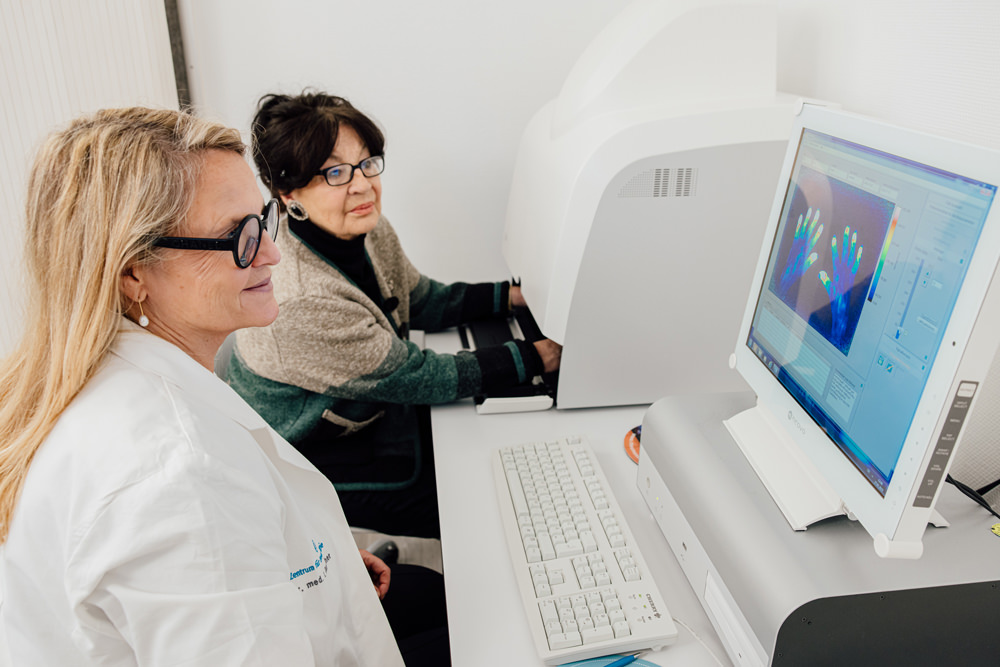
The most important diagnostic element is a detailed and comprehensive medical history. A thorough physical examination with assessment of all joints points the way. This is supplemented by extensive laboratory testing. Imaging includes conventional X-rays of the hands and feet, as these are the hallmark joints of rheumatoid arthritis. Where necessary, the rheumatologist also arranges a joint ultrasound, an MRI scan, a bone scintigraphy or a Xiralite® examination (fluorescence-optical imaging of inflammation in the hands).
The findings fit together like a puzzle. The experienced rheumatologist assesses the overall picture from the clinical complaints, the extensive laboratory tests and the imaging findings.
At the initial consultation at the Centre for Rheumatology, we usually take an hour and explain the findings in detail.

Treating rheumatoid arthritis
The treatment of rheumatoid arthritis involves several groups of drugs.
Initially, anti-inflammatory painkillers (NSAIDs) such as ibuprofen or diclofenac are often used. Once the rheumatologist has confirmed the diagnosis, long-term NSAID use is avoided because of possible side effects and usually inadequate disease control.
Glucocorticoids (steroids, cortisone) are the first choice for achieving rapid improvement of inflammatory disease activity and pain, and for relieving acute pain. The aim is a limited, as short as possible course of steroids until the specific antirheumatic drugs (DMARDs) take effect.
At our rheumatology practice in Heidelberg, our experienced specialists are there for you personally and individually. We advise you on all questions about your condition and carry out comprehensive diagnostics. You are welcome to make an appointment.
Back to all services
Make an appointment